
Hemorrhoid circular stapler
Wound closure is one of the most common clinical procedures in surgery. A doctor or surgeon uses various options such as surgical sutures, adhesive strips and fibrin glue to close wounds in surgical incisions and deep skin injuries. However, all commercial wound closure methods have limitations. In the late 1990s, surgical staplers attracted a lot of attention as wound closure devices because of their effective and sufficient mechanical strength, high performance, lower risk of surgical site infection, and the minimal expertise needed to use them.
The history of the surgical stapler goes back to the early 20th century, when it was invented by a Hungarian surgeon named Hümér Hültl. The first version used by this surgeon weighed 8 pounds, or 3.6 kg, and took two hours to assemble and load. Later, in 1950, the technology was improved in the Soviet Union and the first commercial model was introduced for cardiovascular anastomoses.
In surgery, surgical staplers are commonly used to close incisions in the abdomen or uterus during cesarean sections, because they allow women to recover faster and reduce scar tissue. In addition, surgeons use this device to remove or cut part of an organ and tissue inside the body. Other uses include joining or rejoining internal organs. It is also used in surgery on the digestive tract, including the esophagus, stomach and intestines, where part of these tubular structures is removed and the remaining parts must be reconnected.
Materials commonly used to make surgical staples include stainless steel and titanium. These materials are chosen because both metals are strong and cause the fewest problems for patients during surgery. However, using metal can be problematic, because some people are sensitive to it.
For these people, plastic staples are used, which can reduce allergies and scar tissue. Staples made from polylactide-polyglycolide copolymer are designed to be absorbed by the body. They are often used in cosmetic surgery because, like plastic staples, they cause people less anxiety. Note that staples made of plastic or metal do not dissolve like many sutures, so extra care is needed to prevent infection.
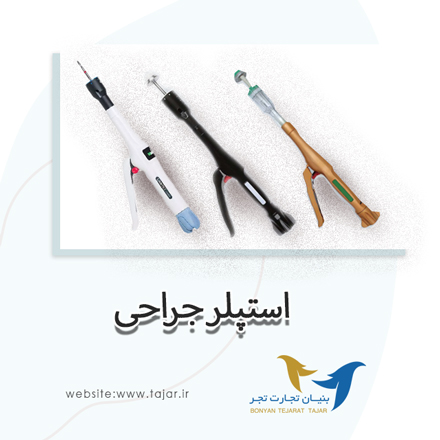
Surgical staplers are available in disposable and reusable versions. Other features include quick placement. They are strong enough and reduce surgery and anesthesia time. They are also easy to remove. The types of surgical staplers and their uses are discussed below.
The first commercial surgical staplers were made of stainless steel with titanium staples. Modern devices on the market today are disposable and made of plastic. There is also a second, reusable type made of stainless steel. Both types are generally loaded with disposable cartridges.
Staple lines are straight, curved or circular. Circular staplers are commonly used in esophageal surgery, including end-to-end anastomoses. These devices may also be used in open or laparoscopic surgery (Laparoscopic circular stapler). Staplers used in this type of surgery are longer and thinner, allowing access through a limited number of trocar ports. Some staplers have a knife that allows complete resection and anastomosis in a single step. This type of device is also used to close skin wounds and internal wounds. Staples used to close skin wounds are applied with a disposable stapler and removed with a staple remover. Staples are also used in vertical banded gastroplasty (commonly known as “stomach stapling”).
Circular staplers are another type of this device, and extensive research has been done on using them for vascular anastomosis. However, although these devices are widely used for circular anastomosis of the digestive tract, they have not had a significant impact on hand-sewn suturing (Carrel technique). Although vascular joining (eversion) differs from gastrointestinal suturing (inversion), vascular sutures require great skill and precision. One exception is organ transplantation, where placing the device on the vascular sutures and firing it can be done at different times, by different surgical teams, under safe conditions, so that the time involved does not affect preservation of the donor organ.
The third type of stapler is the linear stapler , whose most important use is reconstructing the digestive tract after laparoscopic surgery. Here, the device closes the suture line and makes a cut to remove other organs. In abdominal and chest surgery, as well as gynecological and pediatric surgery, this device is used alongside the circular stapler, mainly to cut organs and tissues.
Although most surgical staples are made of titanium, stainless steel is more common in some skin staples and clips. Titanium causes less reaction with the immune system and, being non-ferrous, does not significantly interfere with MRI scanners, although it may cause image artifacts. Absorbable (bioabsorbable) staples are also now available, based on polyglycolic acid, and behave similarly to many synthetic absorbable sutures.
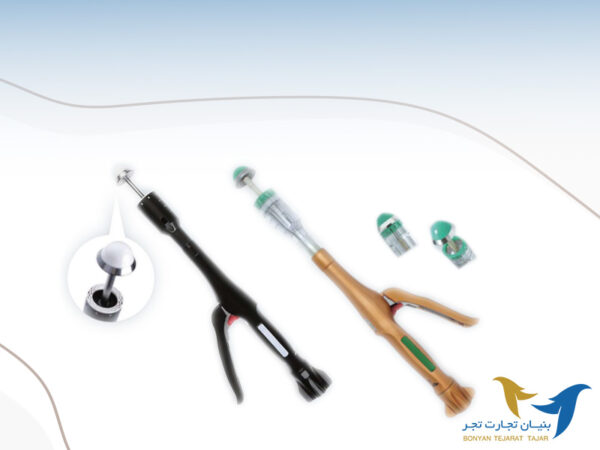
Circular staplers have a circular cartridge and create two interlocking rows of staples. This allows the stapler to join two parts of the stomach or other tubular sections after an organ is removed. The staples trap the tissue in a ring or donut shape between them. An internal blade cuts the covering tissue and seals the new connection.
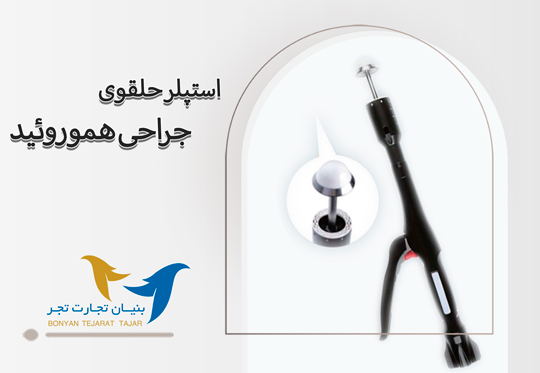
One method used to treat grade 2 to 4 internal hemorrhoids is the circular hemorrhoid stapler. This method is suitable for hemorrhoids and prolapse. Advantages such as fast surgery, mild post-operative pain and quick recovery have made this method popular with surgeons and patients.
In recent years, signs of obstructed defecation syndrome have been observed in some patients with internal hemorrhoids. Internal and external anorectal surgeons use the circular hemorrhoid stapler to perform stapled transanal rectal resection. According to clinical studies by surgeons, this resection can treat obstructed defecation conditions such as rectocele, rectal intussusception, rectal mucosal prolapse and other pathological changes in the lower rectum, with ideal clinical results for both constipation and internal hemorrhoids.
In surgery, The disposable circular hemorrhoid stapler is used to treat anal mucosal prolapse and hemorrhoidal mucosal tissue. One of the most important features of this medical device is its automatic operation, so manual operation is no longer needed. When the stapler starts working automatically, a green dot appears on the display. With this device, surgeons can adjust the closed height based on the thickness of the tissue.
Surgical circular staplers have several advantages, some of which are listed below:
Fast wound closure
In many cases, when injuries are not serious, the surgeon can examine the wound carefully and without haste. But when injuries are serious and bleeding is heavy, the operation takes much longer and the patient needs much more anesthesia. When the patient’s general condition is poor, they need to be transferred to the ICU. Here the stapler’s role becomes prominent, and it is essential to close the wound as quickly as possible to finish the operation. The faster the wound is closed, the shorter the operation and the lower the bleeding and anesthetic dose, which in turn reduces surgical risk. In these special situations where fast wound closure is needed, the circular stapler is highly recommended, because it performs very well when dealing with many injured patients. In such cases, the number of medical staff may be limited and wounds need to be closed as soon as possible.
Acceptable safety
The needle used for ordinary sutures is curved and needs to form the tissue into a pocket during suturing, which can damage the tissue. Compared with ordinary sutures, U-shaped staples cause less damage to skin tissue.
Although circular staplers have advantages, they also have drawbacks, the most important of which are listed below:
Because the stapler’s working space is limited and does not allow fine cosmetic repair, it cannot be used on the face and neck and is generally only suitable for the scalp, trunk and limbs.
This is more noticeable after surgery, especially in the hands, feet and other more active parts of the body.
Because staples are mostly metal, they can appear on X-ray and CT scan images.
Hemorrhoids are one of the most common anal conditions and are caused by swollen blood vessels in this area of the body. They are divided into internal and external types. There are several ways to treat them, one of the most important and best known being stapler surgery, known as stapled hemorrhoidopexy. In this method, a device cuts off the blood supply to the hemorrhoids, so no incision is needed at the site. To cut off the blood supply to the hemorrhoidal vessels, they are moved to a higher point with fewer nerves and tied off so that blood flow stops.
Using a stapler to treat hemorrhoids is considered an invasive treatment and is used for grade 3 and 4 internal hemorrhoids. Although internal hemorrhoids used to be treated under full anesthesia with hospitalization, today the procedure is still done under anesthesia but without the need for hospitalization.
Stapler surgery for grade 3 and 4 hemorrhoids has advantages. The first is that operating time is minimized. It causes little pain and has no complications. People treated this way also experience less bleeding, swelling and itching around the anus and inside the rectum. In addition, stapled hemorrhoidopexy can reduce the risk of incontinence after surgery. On the other hand, this method has drawbacks, the most important being infection, rectal bleeding, fecal incontinence, anal narrowing due to scarring, damage to the anal wall, and difficulty passing stool due to muscle spasms.
References
https://www.tgh.org/institutes-and-services/treatments/hemorrhoidopexy
https://www.sciencedirect.com/science/article/pii/S2590093522000534
Leave a comment.
Your email address will not be published. Required fields are marked *

What Causes Burns in Diabetic Patients? Diabetic neuropathy is the most important cause of burns in people with diabetes. Neuropathy...

Simply put, blood pressure is the force that blood exerts on the walls of your blood vessels. Blood pressure is...
Did you know that modern ostomy bags are odor-free and ordinary people do not notice ostomy patients' bags? To learn...
To buy a product, request a price quote or get specialized advice, contact our sales experts. Our team is ready to provide the information you need and guide you in choosing and buying the right product for your needs.
Leave a Reply