
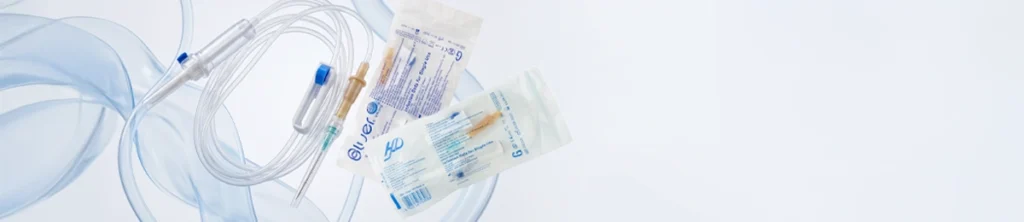
Infusion set
Another supply widely used in medicine today is the IV infusion set. This medical device is used to deliver fluids for intravenous infusion. It serves as a link between the container holding the infusion fluid and the patient’s vein. Sometimes a large volume of fluid needs to be given to a person. However, note that fluid injected under the skin or into a muscle cannot exceed 3 cc, because it causes problems such as fluid accumulation and related problems under the skin.
One of the most important solutions proposed for this problem is injecting fluids directly into the patient’s vein, or intravenous infusion, which can be done with an IV infusion set. This method can be used for a wide range of patients, especially those with heart and kidney failure. This medical device also has other advantages, including control of intravenous infusion: sometimes the infusion must be given at set intervals, or fluid must be delivered at a controlled rate. Using an IV infusion set also reduces the risk of infection and keeps the injection site free of any contamination.
It works on the basis of gravity, which makes the fluid in the container flow downward and into the patient. A more detailed explanation of IV infusion sets follows. Sometimes a drug needs to enter the patient’s circulatory system directly to reach the necessary receptors in the tissue for therapeutic effect; this is done by injecting the drug into the IV fluid and delivering it with an IV infusion set.
Features of Infusion Sets
Infusion sets have unique features, listed below:
They are disposable.
They are usually sterilized with ethylene oxide gas.
Their components are medical grade.
They are non-toxic and do not cause allergies or sensitivity.
Flexible tubing is another advantage of infusion sets.
Their filters prevent any microorganisms from entering the body.
They have connection points that allow them to connect to an IV cannula or scalp vein set.
One advantage is a valve or roller clamp that lets users increase, decrease or, in some cases, stop the fluid flow.
A transparent drip chamber is another feature of infusion sets; medical staff can watch the drops in this chamber and make sure the set is working.
Components of an infusion set
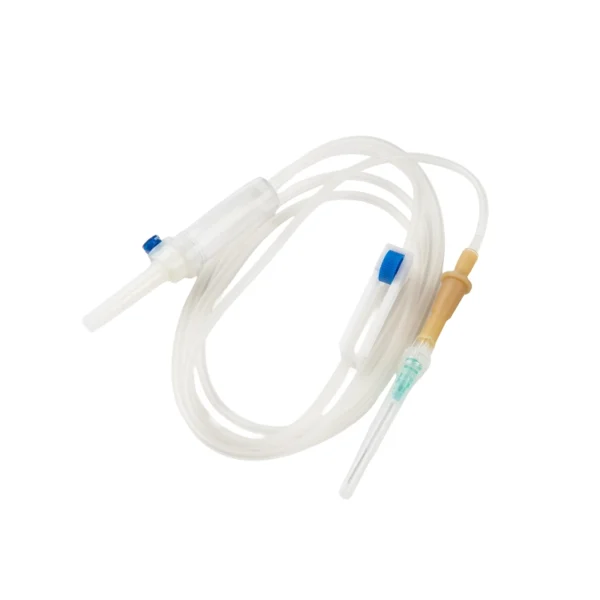
An infusion set is made up of several components, each explained in detail below:
Spike
It is made of acrylonitrile butadiene styrene. It is a hollow device with a double channel and a sharp tapered cannula at the inlet end of the IV set, and it ensures a seal between the IV line and the fluid container (bottle or bag).
The spike must be able to pierce the cap of the IV bag or bottle without causing any contamination. When the spike is placed in the IV bag or bottle, air entering the bag or bottle must not enter the outflowing fluid.
Drip chamber
A transparent, flexible, compressible chamber with a graduated tube at its upper end. This tube produces uniform drops, about 20 drops per 1 ml. One advantage is a bacterial filter at its lower end to retain particles. It is usually made of polyvinyl chloride. The drip chamber has a large, flexible volume without collapsing. Its external volume is not less than 10 cubic centimeters. The wall thickness is uniform, and its minimum thickness is not less than half a millimeter.
It is used in the infusion set so the continuous flow of drops can be seen. Medical staff can tell from the number of drops whether the flow rate is appropriate. If it is not, they adjust it.
One point to note is that the drip chamber should not be more than half full, because then medical staff cannot count the drops. Another important point is that medical staff must make sure the drip chamber is correctly connected to the fluid bag, because otherwise air can enter the patient’s blood, with a risk of dangerous complications such as cardiac arrest or blocked blood vessels.
Filter
Another component of the infusion set is the filter, which is made of polypropylene with pores of about 15 to 18 microns. It filters particles in the fluid and protects patients from any resulting infection. The filter’s filtration rate for latex particles must not be less than 90 percent.
Injection port
The injection port is made of latex-free natural rubber and is located in two places. The first is at the end of the IV tubing, near the infusion site, and the second is on the bag. Two injection sites are used for when two fluids need to be infused at the same time. So, to avoid interaction between the two fluids, one fluid is injected through the port at the end of the IV tubing and the other through the port on the IV bag.
Components of an infusion set
Flow regulator
The flow regulator is made of polyethylene. It is shaped like a small wheel and sits between the drip chamber and the IV connector; it is also called a roller clamp. The roller clamp lets you adjust the fluid by compressing the lumen without damaging the tube. It also allows the fluid to be stopped if needed.
It can adjust the flow from zero to maximum, and it must be adjustable to no less than 30 ml per unit of time. The flow regulator can be used continuously during single infusions without damaging the tube. When stored together with the tubing, it causes no harmful reactions. Besides its main function, the flow regulator clamp or screw has another use: it allows fluid to pass along the entire length of the IV tubing and, if possible, clear all air bubbles from the tube.
Air vent
It is made of polyvinyl chloride. Its most important role is to prevent microorganisms from entering via the infusion bag. In fact, all air entering the container passes through it. If the container is a soft bag, the spike can be used with or without an air vent. But if the container is a rigid bottle, the spike must be used with an air vent, which lets the fluid flow only after air has entered the bottle.
Protective cap
Its most important function is to keep the spike sterile. The cap is secure and easy to remove. It is made of polyethylene.
Luer lock connector
It is made of acrylonitrile butadiene styrene. The Luer taper is a standard system for making leak-free connections between male and female tapered fittings. Luer lock fittings are held more securely because the hub has tabs or threads that engage the threads of the sleeve. It helps create a strong needle connection.
Cap
The infusion set cap is made of polyethylene. One safety recommendation is to cover the exposed end of the IV tubing with a sterile cap during intermittent infusions. This prevents microbes and foreign particles from entering the infusion.
Tube
It is made of medical-grade polyvinyl chloride and is 150 cm long. The infusion set tube is transparent, so when air bubbles pass through it, the interface between water and air can be seen easily and clearly with the naked eye. The tubes have a smooth inner surface to reduce turbulence and prevent air bubbles from forming
Types of Infusion Sets and How to Use Them
There are several types of infusion sets, some of which are described below:
Vented infusion set
Vented infusion sets are suitable for plastic and glass containers. This type has a small vent that opens and closes easily. Opening and closing it lets air into the fluid and moves it. Note that fluid does not flow from a rigid IV container unless air can enter through the vent.
Non-vented infusion set
This type works the opposite way to vented sets and has no vent. Non-vented infusion sets work with flexible plastic containers. In this type, a vacuum needle is used to remove air, which causes the fluid to flow out of the IV bag.
Infusion set with separate needle
This type of infusion set is used to deliver blood and blood products such as platelets. A cap is used to cover the infusion set needle so that, if the infusion is stopped, contamination is prevented and the needle is kept sterile.
Infusion set with needle
This type of infusion set is used to deliver non-blood products such as saline, and a cap is placed at the end of its connector to keep contamination out.
Filtered infusion set
This infusion set has a filter with micron-sized pores to keep contaminants and suspended particles out of the infusion fluid.
PolyMed blue IV cannula
PolyMed blue IV cannula
PolyMed yellow IV cannula
PolyMed yellow IV cannula
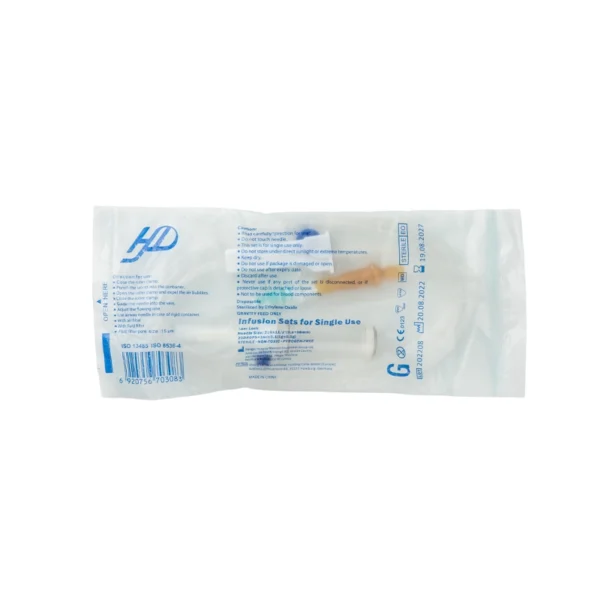
HD infusion set
HD Infusion Set
HD infusion set
Webest Infusion Set
What Are Infusion Sets Used For?
As mentioned, the most important use of the infusion set is intravenous infusion of fluids. It also has other uses, the most important of which are listed below:
Giving medication to the patient in set volumes
One way to spare a person from multiple injections and venipunctures is to use an infusion set together with an IV cannula. In some cases, injections need to be given several times, which would require repeated venipunctures.
Giving medication over a long period in a controlled way
Sometimes medication needs to be given at set intervals, in which case it is best to use an infusion set.
Reducing the risk of infection and preventing contamination
Sometimes infections can appear at the IV site. The site may also become contaminated when connecting fluid lines to the body. Using an infusion set can reduce the risk of infection and protect the person from contamination.
Infusion Set vs. Microset
The microset is a medical device that acts as a link between the infusion set and the IV cannula. It has similarities with and differences from the infusion set. Both work similarly and are used for IV infusion. The difference is that the microset is usually used when fluid must be infused into the patient with high precision and at a controlled rate. The microset is also used more for diluted fluids.
Difference between an infusion set and a scalp vein set
How to Connect an Infusion Set to the Body
The first step in connecting an infusion set to the patient is to place the IV cannula. To do this, insert the cannula needle into the vein gently and very carefully. Once you see some blood collect in the cannula, remove the needle so that only the plastic tube of the cannula stays in the vein. Finally, secure the site firmly with IV cannula tape and connect the infusion set tube. Note that IV fluid from the infusion set can also flow into the patient’s vein through a scalp vein set.
Important Points When Using an Infusion Set
One point to keep in mind when using an infusion set is that several factors can affect how it works. One is the height of the IV bag. As mentioned earlier, gravity moves the fluid and infuses it into the patient. The height of the bag directly affects the pressure on the fluid; the higher the pressure, the faster the fluid is infused. Another factor affecting the infusion rate is the patient’s position.
Infusion Set Price and Purchase
Today, many types of infusion sets from domestic and foreign brands are available on the market. This medical device can be bought from various sources such as pharmacies and reputable medical equipment stores. Bonyan Tajar is one of the best-known and most reputable of these, with an outstanding track record of selling various types of infusion sets at the lowest prices and the best quality