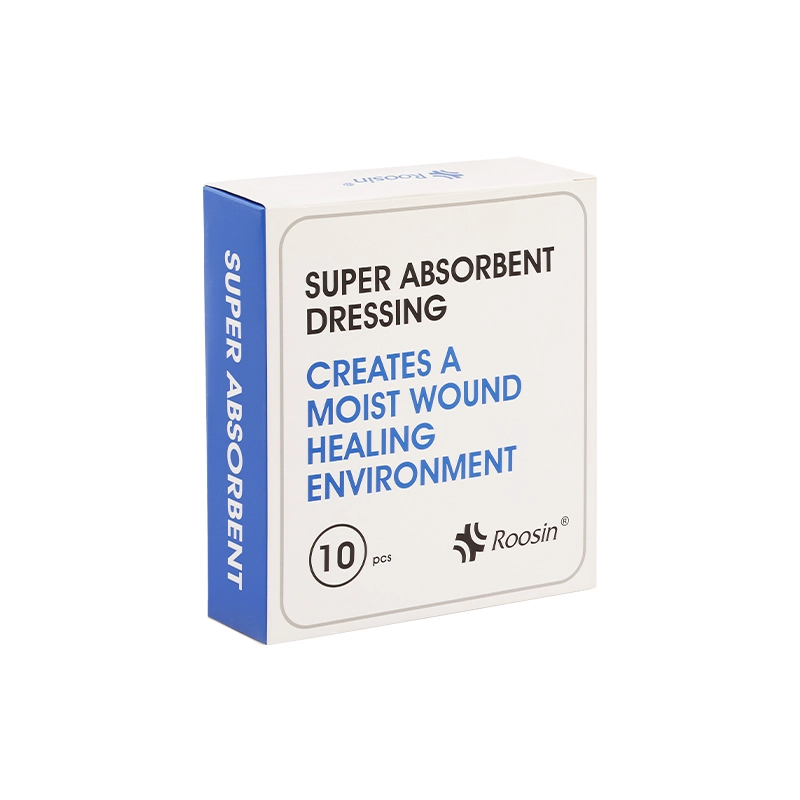
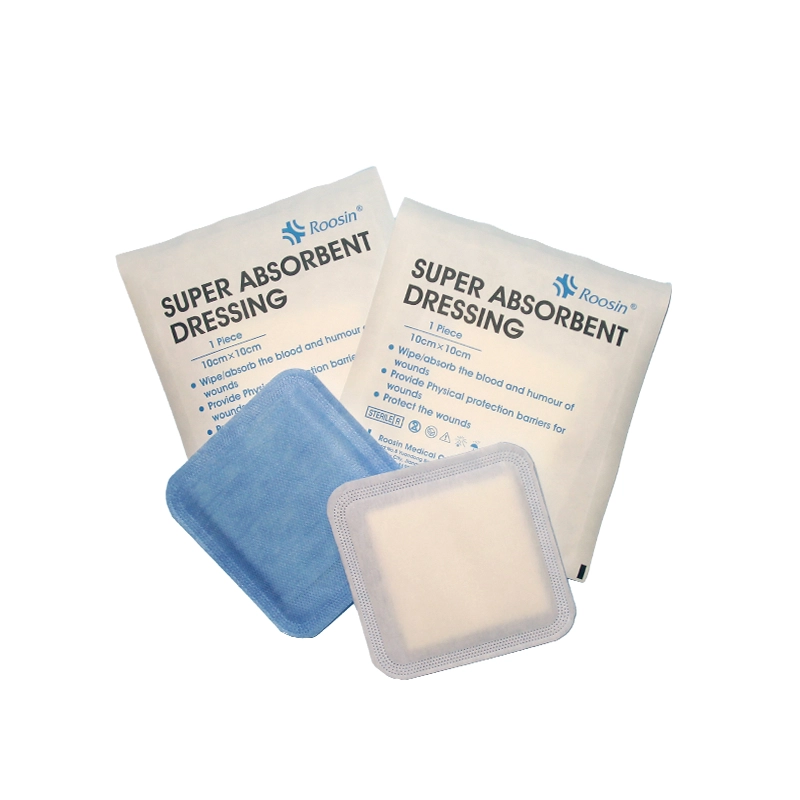
Superabsorbent dressing
Super AbsorbentOne of the best dressings for absorbing a wound’s natural exudate, with a very high absorption rate, is the superabsorbent dressing. This dressing manages and absorbs very large amounts of exudate while its strong structure holds and manages the exudate.


| Country of Manufacture | China |
| Dressing Form | Porous foam sheet (sheet) |
| Components | Made super adsorb SAP polymer |
| Main Feature | Very high capacity to absorb and retain wound exudate; manages the transfer of exudate to the core layer |
| Suitable for Diabetic Wounds | Yes |
| Uses | Traumatic wounds, venous and arterial wounds, absorbing exudate from highly exuding wounds, diabetic foot ulcers, and wounds in the inflammatory phase that are highly exuding |
| Contraindications | Not for use in contact with tendons and ligaments, and not for low-exuding wounds |
| Duration of Use | Change every two to three days |
| Antibacterial | No |
| Can Be Cut | No |
Absorbent or superabsorbent dressings are known as one of the most important types of dressings for wound healing. These dressings are multi-layered and are semi-adherent or non-adherent. Highly absorbent layers made of cellulose, cotton or rayon are also part of their structure. As a result, they can be used as both primary and secondary dressings. The core of the dressing can absorb large volumes of exudate from pressure and venous ulcers, surgical incisions, burns (see the best burn dressings), donor and skin graft sites, and chronic wounds. They are designed to adhere to the wound as little as possible.
The most important uses of this dressing include a wide range of wounds with moderate to very heavy exudate. Other uses of this dressing include:
- Diabetic foot ulcers
- Pressure ulcers
- Venous and arterial leg ulcers
- First- and second-degree burns
- Post-surgical wounds
- Traumatic wounds
Superabsorbent dressings have three layers: a hydrophilic layer, a core layer and a hydrophobic layer. The hydrophilic layer is on the surface and absorbs wound exudate and transfers it to the core, which keeps the dressing from sticking to the wound. The core layer, by applying pressure, retains the exudate (the wound’s natural fluid) and therefore reduces the risk of maceration, while the hydrophobic layer prevents the exudate from returning to the wound. It should be noted that this absorption mechanism is based on the SAP polymer in the dressing’s structure.
The Roosin superabsorbent dressing is one of the advanced dressings and is reasonably priced. Roosin dressings are imported and their cost depends on various factors such as the exchange rate, so an exact price cannot be given. If you would like to know the price of this dressing, you can contact the experts at Bonyan Tajar.
Absorbent dressings are used for a wide range of wounds, from skin tears to heavily draining wounds. They also come in various sizes, which makes them usable for wounds of different sizes and in different parts of the body.
What is the Roosin superabsorbent dressing?
The Roosin superabsorbent dressing is made of viscose fiber, polyester, SAP polymers and more, and is highly absorbent and soft. Its surface has a polyethylene mesh layer that effectively prevents pain when the dressing is changed. It has a wide range of uses, including abrasions. Other advantages are that it does not cause allergies or skin irritation. It also protects the wound from infection.
The Roosin superabsorbent dressing can be used as a primary or secondary dressing and is suitable for healing wounds with moderate to heavy exudate, as well as partial- and full-thickness wounds. Wounds it is effective for include dehisced wounds, wounds with moderate to heavy exudate, diabetic foot ulcers, pressure ulcers, surgical wounds and venous ulcers. The most important advantages of the Roosin waterproof dressing include:
Suitable for many types of wounds with moderate to heavy exudate
Prevents maceration of the wound edges
Only a small amount of product is needed
Provides patient comfort
How the Roosin Superabsorbent Dressing Works
This dressing uses polymer particle technology with high absorption and swelling capacity, which provides exceptional absorption through osmotic pull that draws fluid to the back (the back and core) of the dressing. The polymer particles lock the fluid components of the exudate inside the dressing and turn them into a gel. One advantage of this dressing is that it reduces the risk of maceration by transferring exudate directly to the back and core of the dressing, away from the wound. In addition, the outer layer acts as an extra cushion and redistributes pressure.
How Superabsorbent Dressings Work in Wound Treatment and Healing
Dressings containing superabsorbent polymers can absorb large amounts of exudate. They work by absorbing or retaining fluid and turning it into a gel, which protects the wound and the surrounding skin from the exudate. This type of dressing is suitable for moderate to high amounts of exudate.
When to Change a Superabsorbent Dressing
Superabsorbent dressings usually stay on the wound for several days, depending on the wound’s condition. As mentioned, this dressing is used for many types of wounds whose characteristics and care conditions matter. It should be checked to make sure its pores are not blocked by thick exudate or other material. Also, although the wound’s condition can be seen through the dressing, it should be changed if the physician needs to examine the wound closely.
Uses of Superabsorbent Dressings
It is used as a primary or secondary dressing for partial- and full-thickness wounds. It is also used when there is a moderate to large amount of exudate, high absorbency is needed, and the dressing needs to be changed less often. This dressing is very suitable for heavily draining venous ulcers. Other uses of superabsorbent dressings include pressure ulcers, leg ulcers, diabetic ulcers, surgical wounds, graft and donor sites, lacerations and abrasions.
Contraindications of Superabsorbent Dressings
This dressing is not recommended for patients who are highly sensitive to it or its components (such as the superabsorbent polymer sodium polyacrylate). It also cannot be used for tunneling wounds because it expands significantly as it absorbs exudate. It is not used for wounds with no or little exudate because it would dry out the wound. Note that Roosin superabsorbent dressings should not be in direct contact with infected tendon and ligament wounds.
Advantages and Disadvantages of Superabsorbent Dressings
The main disadvantage of this dressing is that it cannot be used for wounds with no or little exudate, but like other advanced dressings it has advantages, the most important of which are:
Can be used as a primary or secondary dressing for wounds with moderate to heavy exudate
For its size, it can absorb large amounts of exudate.
The non-adherent layer does not stick to the wound
Helps wound healing by providing a moist environment.
The waterproof layer on the back of the dressing reduces the risk of wetting the wound site and protects against impact.
Speeds up healing by promoting granulation tissue.
Does not need frequent changing, which in turn saves money.
How to Use Superabsorbent Dressings
To use superabsorbent dressings, it is best to follow these steps:
Clean the wound site.
Take a dressing of the right size so that it covers the wound edges. Note that this type of dressing cannot be cut.
Remove the dressing from its packaging aseptically and place the white side of the dressing in contact with the wound surface and its exudate.
Then cover the dressing with a secondary dressing.
Check the dressing regularly and change it as needed and according to medical instructions.