
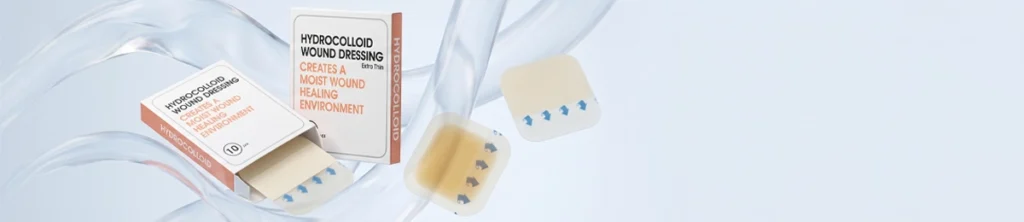
Hydrocolloid dressing
Today, using dressings in wound healing has attracted special attention as a way to protect and treat wounds. There are many types of dressings, each with its own unique features. One type is the hydrocolloid dressing, which can be used both as a primary dressing and as a secondary dressing (to protect and hold a primary dressing in place).
These dressings consist of a self-adhesive layer of hydrophilic colloid particles such as carboxymethyl cellulose, pectin or gelatin. When hydrocolloid dressings come into contact with wound exudate, they absorb it and swell into a gel-like substance that provides a moist environment for wound healing. The outer layer, made of polyurethane and waterproof, protects wounds from external agents such as bacteria. These dressings come in various forms (paste, powder, granules and so on) and shapes (square, rectangle, circle and so on).
The most important feature that sets them apart from other dressings is that they do not need frequent changes. They are also easy to use. In addition, these dressings are very suitable for areas of the body where wounds are hard to dress, such as elbows and heels. These dressings are usually suitable for wounds that are:
Clean and non-infected.
Free of any dirt.
Of moderate depth.
Dry or with little moisture.
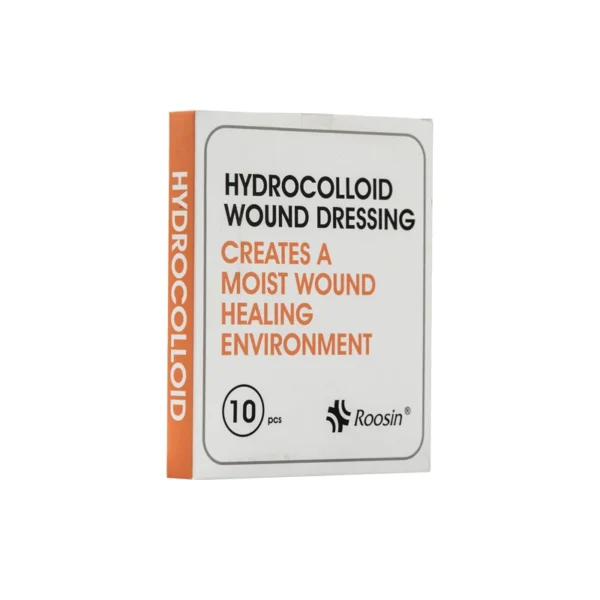
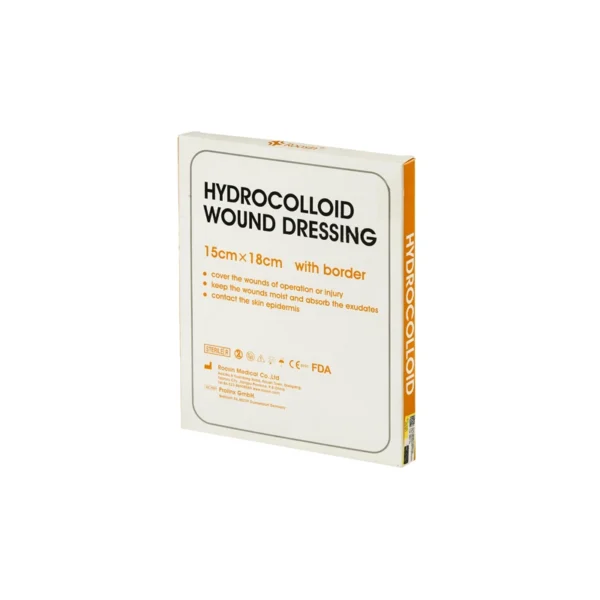
Types of Hydrocolloid Dressings
There are several types of hydrocolloid dressings, the most important of which are listed below:
Silver hydrocolloid
Contains silver particles that release set amounts of silver onto the wound to create an antibacterial or antimicrobial environment. Silver dressings are used as both primary and secondary dressings and are suitable for healing wounds with low, moderate and heavy exudate.
Thin hydrocolloid dressing
This dressing has rounded corners that prevent it from rolling during use. It also makes it easy to monitor wound healing while in use.
Standard hydrocolloid
Provides a moist environment for wound healing. This dressing is suitable for low-risk wounds. It is waterproof and suitable for use while bathing.
Alginate hydrocolloid dressing
Suitable for wounds with low to moderate exudate, providing a moist environment for wound healing. The alginate dressing offers greater exudate absorption, which in turn means fewer dressing changes.
Transparent hydrocolloid
Thin and flexible, it greatly helps wounds heal quickly.
Uses of Hydrocolloid Dressings
These dressings are used to treat many types of wounds, the most important of which are listed below:
Deep and partial-thickness wounds
also known as full- and partial-thickness wounds. Because these wounds should not be disturbed too much, it is best to use hydrocolloid dressings, as they do not need frequent changes.
Granulating and necrotic wounds
This dressing can be used when the wound is in the granulation stage, and it is also used to remove necrotic tissue by creating moisture.
Chronic pressure ulcers
Chronic pressure ulcers caused by pressure on part of the body. These include grade 2 wounds.
Wounds with low to moderate exudate and major surgical wounds
Major surgical wounds, such as deep surgical wounds in the chest and abdomen where all layers are incised.
Advantages of Hydrocolloid Dressings
As mentioned, hydrocolloid dressings last longer than other types of dressings, so they do not need frequent changes. They can also speed up healing because of the following features:
They provide a moist environment that lets the body’s enzymes help speed up healing.
They are flexible enough to fit around the skin and other parts of the body.
They are impermeable to bacteria and other contaminants.
They do not stick to the wound.
Disadvantages and Side Effects of Hydrocolloid Dressings
These advanced dressings are not suitable for all types of wounds and cannot be used for infections and heavily exuding wounds. Other disadvantages include:
Assessing the wound through the dressing can be difficult.
The dressings may roll or curl at the edges.
They are not indicated when the wound has heavy exudate or is infected
The dressings can cause maceration around the wound or hypergranulation.
Sometimes the dressing sticks to the wound and can damage fragile skin when removed.
Permeability of Hydrocolloid Dressings
As mentioned, hydrocolloid dressings have two layers. The inner layer is adhesive and contains particles that absorb wound exudate and form a gel-like substance. This substance creates a moist environment for the wound and leads to faster healing. The outer layer protects the wound from any contamination. These dressings are adequately permeable to vapor but impermeable to microorganisms. They are also waterproof, so bathing is not a problem.
When to Change a Hydrocolloid Dressing
Hydrocolloid dressings usually last 3 to 7 days. Because these dressings keep wounds moist, they do not need to be changed daily. In addition, wounds covered with these dressings heal faster if they are not constantly exposed to air. As mentioned earlier, it is difficult to check wounds through hydrocolloid dressings, so the type of dressing used for a wound is very important. These dressings are usually used for wounds that are completely clean and free of infection.
Hydrocolloid dressing
Contraindications for Hydrocolloid Dressings
As mentioned, hydrocolloid dressings should never be used for infected wounds. In addition, they should not be used for dry burn wounds, deep heavily exuding wounds or heavily exuding diabetic wounds.
Guide to Using Hydrocolloid Dressings
Hydrocolloid dressings are used like other types of dressings, as follows:
1- Wash your hands and put on gloves.
2- Clean the wound with saline or a wound cleanser.
3- Dry the wound with clean gauze.
4- Take a hydrocolloid dressing one to two inches larger than the wound
5- Hold the dressing between your hands to warm it, as this helps it stick better.
6- Peel the backing off the dressing.
7- Fold the dressing in the middle and apply it from the center of the wound outward.
8- Smooth the dressing from the center outward and hold it to improve adhesion. If the dressing does not stick, or to be sure it stays in place, use tape.
9- Throw away the dressing waste, remove your gloves and throw them away too.
Guide to Removing a Hydrocolloid Dressing from a Wound
1- Press on the skin near the edge of the dressing and lift the adhesive from one side.
2- Keep lifting the edges of the dressing until all the adhesive is released.
3- Carefully remove the dressing from the wound in the direction of hair growth.
4- If a new dressing is needed, repeat the steps above.
Effect of Hydrocolloid Dressings for Diabetic Patients
These dressings can be used for patients with diabetic wounds. However, hydrocolloid dressings must be used with great caution in people with diabetes, especially for foot ulcers. When using these dressings on the feet of people with diabetes, note the following:
The patient’s condition has been fully assessed before use.
The wound is superficial and shows no signs of infection.
The wound has low to moderate exudate.
There are no signs of ischemia.
Dressings are changed regularly.
At the same time, it is important that the hydrocolloid dressing is chosen correctly based on the type and healing stage of the wound and the amount of exudate
How to Store Hydrocolloid Dressings
Dressings should be stored at room temperature, out of sunlight, and away from any moisture and freezing.
Price of Hydrocolloid Dressings
Several brands of this product are available on the market, the most important being Comfeel, Renucare, Convatec, Coloplast and Hydrocoll. Hydrocolloid dressings are also available at various prices, ranging from 30,000 Tomans to over 200,000 Tomans.