Components and How Vacuum Blood Collection Tubes Work
These tubes work on the pressure difference between the blood vessel and the vacuum in the tube, which draws blood through the needle into the tube. As shown in the figure below, vacuum blood collection tubes use a double-sided needle. The inner end of the needle is covered with a thin rubber sleeve to prevent blood from leaking when tubes are changed during multiple draws, that is, when several tubes are used and each full tube is replaced by another. The outer end of the needle goes into the vein. There is also a plastic needle holder. When the needle is screwed into the holder, the inner end of the needle sits inside the holder.
When the tube is placed in the holder, its rubber stopper is pierced by the inner needle, and the vacuum in the tube draws blood through the needle into the tube. Once the blood is collected, the full tube is replaced with another collection tube, which fills in the same way. The amount of air evacuated from the tube determines how much of the tube fills with blood.
Advantages of Vacuum Blood Collection Tubes
Vacuum blood collection tubes have the following advantages:
- Accurate graduation
- Easy to use with acceptable safety
- Prevents blood contamination of the environment
- Environmentally friendly thanks to the PET plastic tube
- Prevents contact between a suspect patient’s blood and medical staff
- Allows simultaneous blood collection in several tubes with different additives
Types of Vacuum Blood Collection Tubes
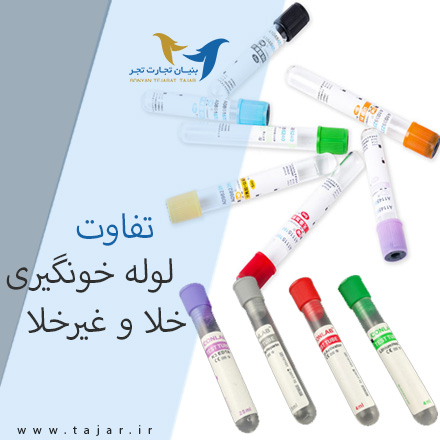
The additives in vacuum blood collection tubes are thin film coatings applied with an ultrasonic nozzle. Note that choosing the wrong tube can make the blood sample unusable for its intended purpose. For example, if the goal is to measure blood chemistry parameters such as blood sugar, cholesterol, triglycerides, urea, enzymes, liver tests, creatinine and electrolytes, gel clot activator tubes with a yellow cap in volumes above 5 ml and 8 ml are used.
The additives used in vacuum blood collection tubes fall into two groups. The first group is anticoagulants, including sodium citrate, heparin and ethylenediaminetetraacetic acid (EDTA). The second group is clot activators, with or without separator gel. The separator gel forms a barrier between blood cells and plasma. In addition, some gel-free vacuum tubes contain additives that protect certain blood components or substances, such as glucose.
Then, when the blood is centrifuged, its components separate by density, so the blood cells collect at the bottom of the tube and the plasma or serum at the top.
In summary, the types of vacuum blood collection tubes are shown in order of importance in the table below:
| Cap Color |
Additive |
Use |
| Yellow |
Gel & clot activator tubes |
Commonly known as serum separator tubes, used for biochemistry and serology tests such as BMP, CMP, LFT and KFT, blood bank studies, HLA phenotyping, paternity testing and tissue typing |
| Violet |
EDTA K2 EDTA K3 |
Blood grouping (Rh factor and ABO), CBC tests, blood cell indices, ESR using the Wintrobe method, hemoglobin (Hb), trace elements such as copper and zinc, toxicology and nutrient testing |
| Red |
Clot activator (gel-free clot tubes) |
Serology and lipid tests, blood bank processing, BMP and CMP |
| Black |
ESR (sodium citrate 3.8%) |
ESR using the Westergren method |
| Green |
Lithium heparin
Sodium heparin |
Plasma tests such as comprehensive and basic metabolic panels, arterial blood gas analysis, TNF-alpha, immunotherapy and lymphocyte tests |
| Blue |
PT (sodium citrate 3.2%) |
Coagulation tests such as prothrombin time, activated partial thromboplastin time, thrombin time and fibrinogen |
Wide variety at a fair price
The following types of vacuum blood collection tubes are available; contact our sales team for a price quote
Blood Collection Steps Using Vacuum Tubes
One point to keep in mind during blood collection is that medical staff must collect samples in a specific order to prevent contamination of samples by additives in different tubes. The order used for tubes is the same whether blood is drawn with a syringe, a tube holder or pre-evacuated tubes. The correct order of blood collection tubes is:
- Blood culture tube or bottle
- PT tubes, sodium citrate 3.2% (blue)
- Clot activator tubes and gel & clot activator tubes (red and yellow)
- Lithium heparin and heparin tubes (green)
- EDTA K2 and EDTA K3 tubes (violet)
- Sodium fluoride tubes (gray)
Vacuum vs. Non-Vacuum Blood Collection Tubes
As their names suggest, the difference between these two devices is whether or not they contain a vacuum. Vacuum tubes fill with blood according to their vacuum level and do not fill with more or less than their standard volume. Another advantage of vacuum tubes is that they do not need to be filled with a syringe; they draw blood through the needle and fill. They are also easy and safe to store, so the risk of contaminating blood samples is very low. Non-vacuum tubes, by contrast, lack these advantages, and their main drawback is that after drawing blood, medical staff must transfer the blood manually from the syringe into the collection tube.
Aosaite Vacuum Blood Collection Tubes
Shandong Aosaite Medical Equipment Co., Ltd is a leading manufacturer of vacuum blood collection tubes. The company holds reputable international certifications and standards such as ISO 13485, CE, and safety, efficacy and performance evaluation reports. Wide variety, good quality, affordable prices and attractive designs are the most important features of its products. Bonyan Tajar, a well-known supplier and seller of medical equipment and supplies, is this company’s representative and supplies and sells many types of blood collection tubes, such as gel clot tubes, CBC tubes, gel-free clot tubes, ESR tubes, lithium heparin and sodium heparin tubes, and PT tubes.
Advantages of Aosaite Vacuum Blood Collection Tubes
- The walls of Aosaite vacuum blood collection tubes are clear enough that the color of the blood is easy to see.
- The silicone cap of Aosaite vacuum tubes has a large contact surface designed for easy connection with the blood collection needle.
Price and Purchase of Vacuum Blood Collection Tubes
Bonyan Tajar, founded in 2010, is a well-known Iranian company with an outstanding track record in trading medical and commercial goods. One of its most important activities is supplying and selling blood collection tubes to buyers at fair prices and excellent quality. Because of exchange rate fluctuations, please call us for a price quote at 02188932240 – 02142279 .




Leave a Reply