Fever: How Does It Happen?
Before discussing the types of thermometers, let’s look at what fever is and what causes it.
A person’s average body temperature varies with age, sex, activity level and the part of the body where temperature is measured. Sometimes, due to factors such as vaccination or heatstroke, normal body temperature rises, in which case the person may have a fever. Based on severity, fever occurs in four levels:
- Low-grade fever: 37.3 to 38 °C
- Moderate fever: 38.1 to 39 °C
- High fever: 39.1 to 40 °C
- Very high fever or hyperthermia: Over 41 °C
Depending on your age, you can use the table below to determine your normal body temperature. Note that the average temperature differs from one part of the body to another.
| Age |
Mouth |
Rectum and ear |
Armpit |
| 0 to 12 months |
36.7 to 37.3 |
37 to 37.9 |
36.4 to 37.3 |
| Children |
36.4 to 37.3 |
37 to 37.9 |
35.9 to 36.83 |
| Adults |
35.6 to 36.7 |
36.1 to 37.2 |
35 to 36.1 |
| Adults over 65 |
33.9 to 37 |
34.4 to 37.6 |
33.3 to 36.4 |
| * All values are in degrees Celsius. |
Types of Thermometers for Different Age Groups
As mentioned, temperature differs in different parts of the body, which is why a wide range of thermometers has been designed. Five types of medical thermometers are discussed below:
Digital (clinical) thermometer
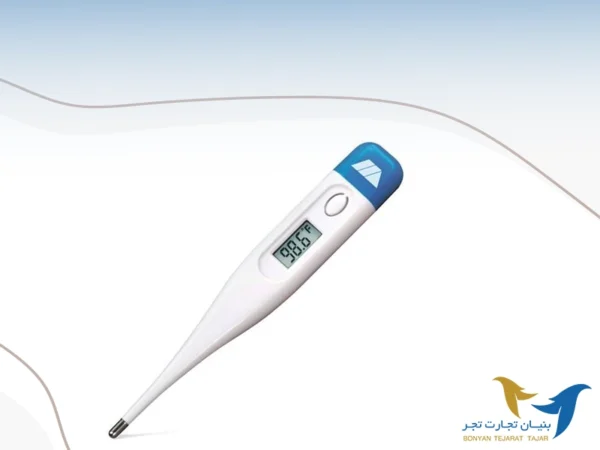
Digital or clinical thermometers are among the most popular and affordable types of thermometer. This type uses heat sensors to determine body temperature. Its most important feature is very high accuracy, and it is known as the most accurate type of medical thermometer.
Digital thermometers come in contact and non-contact types, and each measures temperature differently.
Contact digital thermometers
As the name suggests, this type measures temperature through contact with part of the body. Contact digital thermometers come in three types: oral, rectal and underarm.
Under-the-tongue (oral) thermometer
Oral digital thermometers are placed under the tongue and measure temperature within a few minutes. This type is most accurate in children over 3 and adults.
Rectal thermometer
Rectal thermometers are usually suitable for infants and young children because of their high accuracy. Given where the thermometer is placed, using it can be a little uncomfortable, so it is recommended to use a rectal thermometer with a flexible tip or a lubricant such as petroleum jelly on the tip.
Underarm (axillary) thermometer
This type of thermometer is usually used for infants under 3 months, for whom measuring temperature by mouth is not possible. Measuring body temperature under the arm is less accurate, so many doctors recommend adding one degree to the reading to improve accuracy.
Non-contact digital thermometers
Unlike the contact type, these thermometers do not need to touch the body; body temperature is measured using infrared technology. Non-contact digital thermometers come in ear (tympanic) and forehead (temporal) types.
Ear (tympanic) thermometer
An infrared ear thermometer is inserted into the ear canal and measures the infrared radiation emitted by the eardrum as the heat source. Readings from this type of thermometer are fast and highly accurate.
The device’s position in the ear is very important because it affects the results. The thermometer does not sit properly in small or curved ear canals. Ear thermometers are therefore not recommended for children under 6, because their ear canals are small. Blockages such as earwax also skew the results.
Digital forehead (temporal) thermometer
Also known as an infrared skin thermometer. This type is very popular because it can show the temperature in a few seconds, which is why it is used in airports, train stations, shopping centers and other places.
Where you place a digital forehead thermometer greatly affects the accuracy of the results. It is recommended to place the infrared sensor near the superficial temporal artery, which lies between the outer edge of the eye and the hairline.
Other factors that can affect temperature readings include wind, forehead sweat, direct sunlight, holding the device too far from or too close to the forehead, and wearing thick clothing such as coats and hats.
Mercury thermometer
Because of their very high accuracy, mercury thermometers were widely used in the past and could be used orally, rectally or under the arm. Because of environmental problems and the risks to people, this type of thermometer is no longer used today.
A mercury thermometer is made of glass, with a bulb at the end containing highly toxic and dangerous mercury. If the glass breaks, it can injure the person and release the mercury. Besides safety problems, they are also hard to read, because the thermometer must stay in place for 3 minutes.
Forehead strip (rubber) thermometer
Forehead strip thermometers are known as the least invasive and least disruptive way to measure children’s body temperature. To read the temperature, hold the strip on the forehead for one minute until the color registers along it. The drawback of this type is low accuracy, so it is recommended to add one degree to the reading.
Online thermometer
Today there are mobile apps that let you measure your body temperature online. Thermometer apps rely on digital thermometers that connect to the app via Bluetooth. Interestingly, these apps measure the ambient temperature, not your body temperature, so their results are not reliable.
Pacifier thermometer
Another type of thermometer used for infants. Its most important advantage is that it is easy to use. Pacifier thermometers have drawbacks. One is that they must stay still in the mouth for up to 6 minutes. Second, they give an approximate temperature rather than an accurate reading.
The Best Thermometer Brand
Checking body temperature with a reliable medical thermometer can greatly help manage illness at home. Most thermometers can give accurate results within a few seconds. You may wonder which of the thermometers described so far is the best and most accurate.
The answer is that digital thermometers are known as the most accurate type. However, the best thermometer is one that is easy to use, takes correct measurements and comes from a trusted brand.
How to Use a Digital Thermometer
Digital thermometers are easy to use, and you can learn how from the instructions that come with the product. How you use a digital thermometer depends on its type, because it must be placed at a specific part of the body to read the temperature. How to use this device is explained below:
1- Before measuring, wash your hands thoroughly and dry them. Also clean and disinfect the thermometer.
2- Depending on the type of thermometer, place it in the right spot. For example, if you are using an oral model, put the tip under the tongue with the mouth closed. If it is an underarm model, place the tip in the child’s armpit.
3- After placing the thermometer, wait about a minute for the measurement. When you hear the beep, you can remove it and read the temperature.
Thermometer Price and Purchase
By now you are probably familiar with the types of thermometers and can use this information to buy one. When buying this product, we recommend considering factors such as the type of thermometer, the patient’s age, how quickly results are shown, accuracy, ease of use and extra features such as memory.
Bonyan Tajar is one of the largest suppliers of the most accurate type of medical thermometer: digital thermometers. Our products are varied, of very high quality and very reasonably priced. Before buying, you can contact our experts to find out thermometer prices.
The Thermometer: A Device for Measuring Body Temperature
In this article, we have tried to introduce you to the types of medical thermometers and how to use them. As shown, digital thermometers are the most accurate medical thermometers and come in contact models (oral, underarm and rectal) and non-contact models (ear and forehead).
Finally, if you have questions about any type of thermometer or want to share your knowledge with us, you can use the comments section. Keep in mind that your suggestions and comments can help improve our content.



Leave a Reply